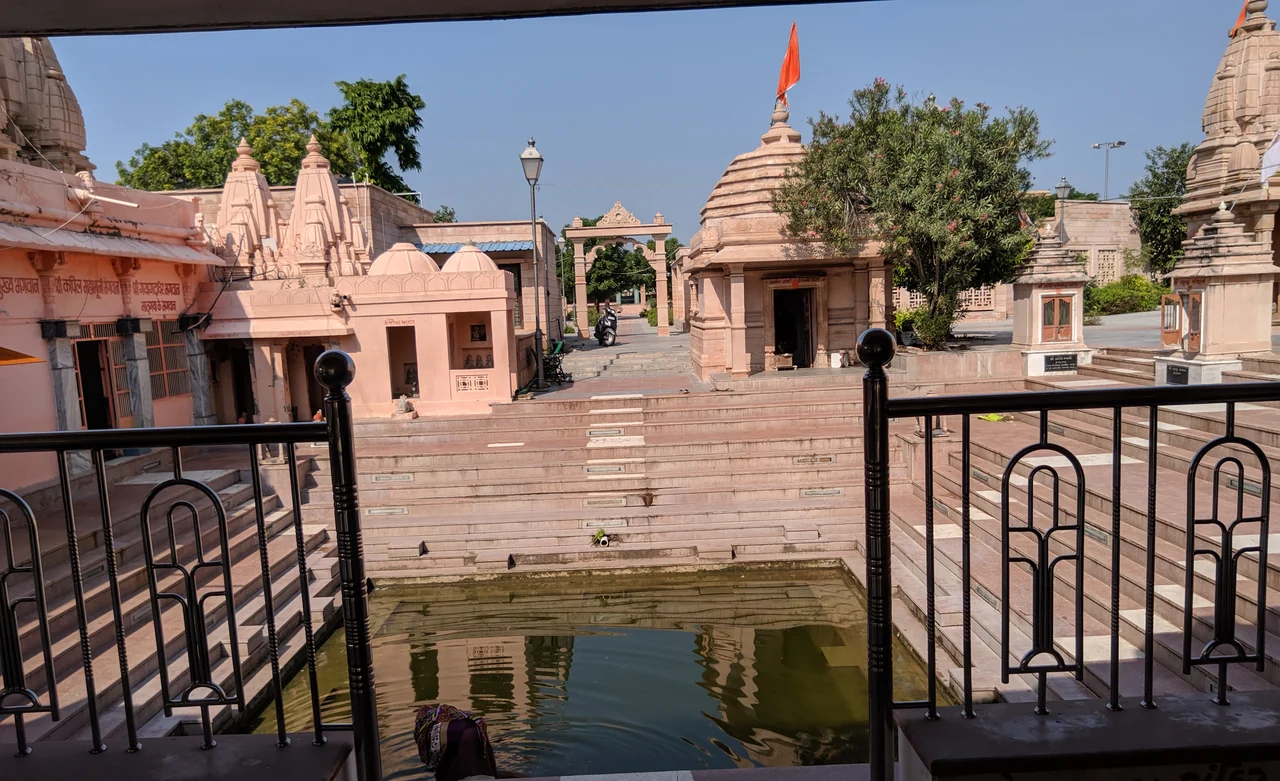
Bindu Sarovar: the centre of Matru Gaya
Families come to Bindu Sarovar for matru shraddha, rites in remembrance of a departed mother. This tradition gives Siddhpur its Matru Gaya identity.
Bhagavata Purana 3.21.38–39 describes Bindu lake as a holy place supplied by the Sarasvati and connected with Kardama’s spiritual practice. Its name comes from Vishnu’s tears of compassion: bindu means a drop. Satsangi Jivan, Prakaran 2, chapter 40.9–14 places Kardama, Kapila and Devahuti’s story in its Siddhpur account.
These references explain the lake’s sacred identity. The Bhagavata verses themselves do not prescribe an exclusive rule that a mother’s shraddha must take place at Siddhpur.
Kapila, Devahuti and Kardama’s shrines
Kardama and Devahuti are Kapila’s parents. After Kardama leaves for the forest, Kapila remains with his mother and teaches her the spiritual path; Bhagavata 3.25.5 introduces this part of the narrative. Her attainment is associated with the name Siddhapada in 3.33.31.
Shrines around Bindu Sarovar preserve the memory of these figures. BAPS’s 2001 visit record identifies Kardama and Devahuti’s shrines; its photograph captions also identify a shrine dedicated to Kapila. Their story of teaching and spiritual attainment gives the pilgrimage its mother-and-son association. It should not be retold as Kapila performing funeral rites for Devahuti: she is alive during his teaching.
Gnan Vav and Kapila’s teaching
Gnan Vav is the stepwell traditionally associated with Kapila teaching Devahuti. BAPS’s shrine photograph captions identify it in those terms. It is a place to remember their spiritual dialogue within the wider Bindu Sarovar pilgrimage.
The source for the teaching itself is the Bhagavata; the identification of this particular stepwell comes from the living religious tradition documented by BAPS.
Ahalya Sarovar and Moksha Peepal
Ahalya Sarovar adjoins Bindu Sarovar, and Moksha Peepal is the sacred peepal tree beside the lake. Both are identified in BAPS’s 2001 photograph captions. They belong to the same pilgrimage surroundings as the main lake and its shrines.
Satsangi Jivan 2.40.20 includes shraddha with pindas, feeding and charity according to one’s means among pilgrimage observances. It supplies a ritual reference for this account; it does not provide a separate ancient origin story for each structure or tree visible today.
Where the text says it
The passages, references and meaning
The passages below support the place descriptions above. Each identifies the text and chapter, followed by a plain-language meaning. A mahatmya is an account of a place’s sacred importance; its descriptions of spiritual benefits express the text’s religious teaching.
Shrimad Bhagavata Purana 3.21.38–39
यस्मिन् भगवतो नेत्रान्न्यपतन्नश्रुबिन्दवः ।
कृपया सम्परीतस्य प्रपन्नेऽर्पितया भृशम् ॥ ३८ ॥
तद्वै बिन्दुसरो नाम सरस्वत्या परिप्लुतम् ।
पुण्यं शिवामृतजलं महर्षिगणसेवितम् ॥ ३९ ॥
Meaning: The Lord's tears fall from compassion for Kardama. The resulting Bindu lake is described as sacred, supplied by the Sarasvati and frequented by great sages.
This explains the sacred lake's name and setting in Kardama's story. The identification with Siddhpur is carried by the place's later religious tradition.
View the source for this passageShrimad Bhagavata Purana 3.25.5
पितरि प्रस्थितेऽरण्यं मातुः प्रियचिकीर्षया ।
तस्मिन् बिन्दुसरेऽवात्सीद्भगवान् कपिलः किल ॥ ५ ॥
Meaning: After Kardama left for the forest, Kapila remained at Bindu lake for the sake of his mother.
Devahuti is living in this passage. What follows is Kapila's teaching to her, rather than an account of funeral offerings.
View the source for this passageShrimad Bhagavata Purana 3.33.31
तद्वीरासीत्पुण्यतमं क्षेत्रं त्रैलोक्यविश्रुतम् ।
नाम्ना सिद्धपदं यत्र सा संसिद्धिमुपेयुषी ॥ ३१ ॥
Meaning: The place where Devahuti attained spiritual perfection became known as the holy Siddhapada.
The preceding verse attributes her attainment to the path taught by Kapila. Siddhpur's tradition identifies its sacred landscape with this account.
View the source for this passageSatsangi Jivan · Prakaran 2, 40.14 and 40.20
प्राप्ता सिद्धदशामत्र देवहूतिस्ततो जनाः ! ।
तेन सिद्धपदं प्रोक्तं क्षेत्रमेतन्महर्षिभिः ।। १४
[…]
तीर्थे कार्यश्चोपवासः क्षौरं श्राद्धं सपिण्डकम् ।
विप्राश्च साधवो भोज्या देयं दानं यथाधनम् ।। २०
Meaning: This Siddhpur chapter links Bindu Sarovar with Kardama, Vishnu's tears, Kapila and Devahuti. Verse 14 explains Siddhapada through Devahuti's attainment. Verse 20 includes shraddha with pindas, feeding and giving according to one's means among pilgrimage observances.
This is a Swaminarayan religious text. Verse 20 gives a general instruction about pilgrimage rites; it does not establish an exclusive mother-only rule for Siddhpur.
View the source for this passageOriginal texts and other sources
Use the links below to read the source passages. Chapter and verse numbers follow these editions; another edition may arrange them differently.
- Shrimad Bhagavata Purana 3.21.38–39 — SanskritBindu lake, Kardama and Sarasvati. The place identification and Matru Gaya practice are separately attributed.
- Shrimad Bhagavata Purana 3.25.5 — SanskritKapila remaining with his mother at Bindu lake. The place identification and Matru Gaya practice are separately attributed.
- Shrimad Bhagavata Purana 3.33.31 — SanskritDevahuti’s attainment and the name Siddhapada. The place identification and Matru Gaya practice are separately attributed.
- Satsangi Jivan, Prakaran 2, chapter 40.9–14, 20 — SanskritShree Swaminarayan Mandir Bhuj’s text: Siddhpur identification and pilgrimage observances. A Swaminarayan scripture.
- BAPS — Siddhpur visit, 27 September 2001The institution’s own Matru Gaya visit and shrine descriptions.
- BAPS — Siddhpur, shrine photograph captionsIdentifies Kapila’s shrine, Gnan Vav, Ahalya Sarovar and Moksha Peepal.