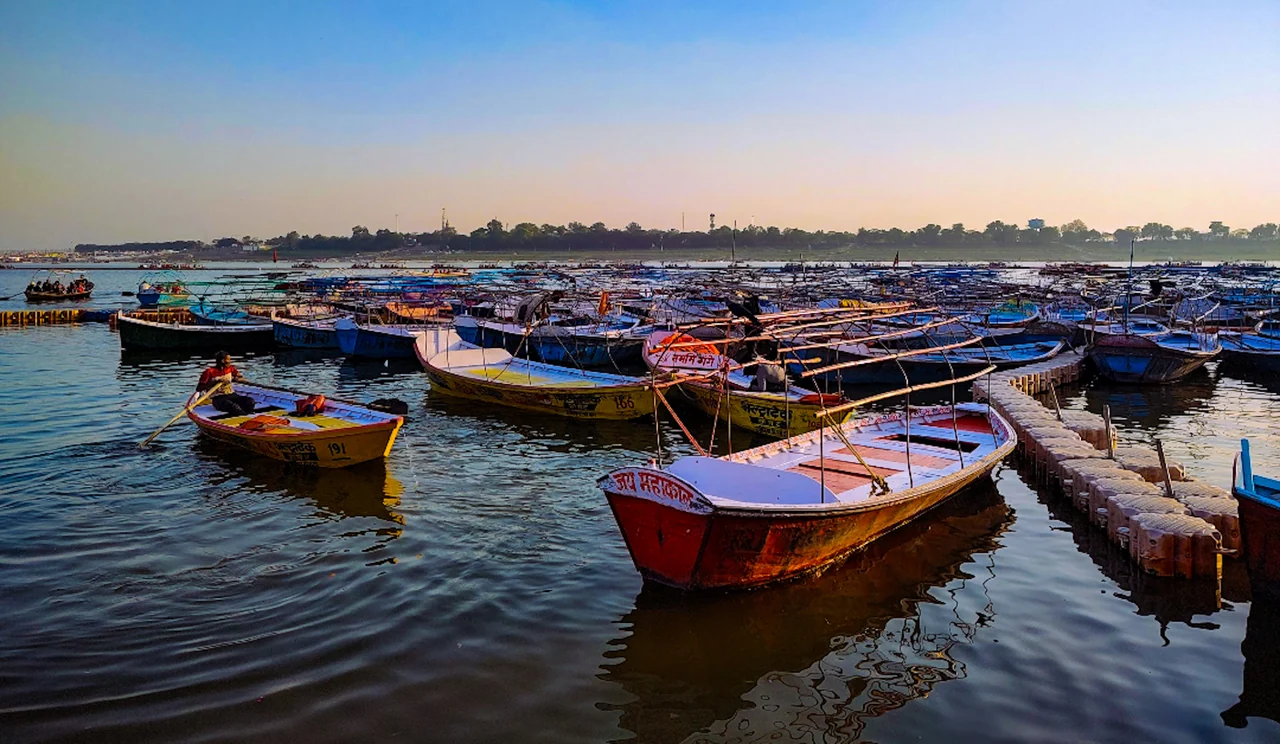
Why shraddha is offered at the Sangam
The meeting of the rivers is the main setting for bathing and ancestral offerings at Prayag. Padma Purana, Uttara-khanda 91.17–18 identifies Prayag through the confluence of the Ganga and Kalindi, another name for Yamuna. Verse 22 specifically praises shraddha offered here for the ancestors and says that, by Vishnu’s boon, they attain his realm.
The religious account also includes Sarasvati. Skanda Purana, Kashi-khanda, Purvardha 7.64 names Sarasvati, Yamuna and Ganga together and gives them a spiritual interpretation through the three gunas. This is part of the Sangam’s sacred identity.
For the ancestral rite, tarpana means the offering of water and shraddha is the wider ceremony. Narada Purana, Uttarardha 63.59 describes a month-long observance at Prayag involving restraint and tarpana to gods and ancestors. That passage describes an extended stay. It does not fix the length of every family’s visit.
Akshayavat: the sacred banyan
Akshayavat is the banyan revered in Prayag’s pilgrimage. Skanda Purana, Kashi-khanda, Purvardha 7.51 recalls Markandeya taking refuge on it during pralaya, the dissolution of the world. Verse 52 praises feeding Brahmins near the tree.
The chapter follows a pilgrim’s journey through several cities, which is why this description of Prayag appears in the Kashi-khanda. Its account links the banyan with Markandeya and feeding, while the explicit shraddha reference at the Sangam is in Padma 91.22. Gaya has another sacred banyan called Akshayavat.
Bharadvaja’s ashram and Rama’s visit
Bharadvaja’s ashram is associated with Rama, Sita and Lakshmana’s stay with the sage during their forest journey. In the Valmiki Ramayana, Ayodhya-kanda 54.7–8 locates the ashram near the Ganga–Yamuna confluence; verses 34–35 name Prayag and describe their stay for the night.
This episode gives the ashram its place in the Ramayana pilgrimage. The ancestral rites at the Sangam have their own references, as set out above.
Madhava: Vishnu’s presence at Prayag
Skanda Purana, Kashi-khanda, Purvardha 7.53 describes Vishnu, the Lord of Lakshmi, coming from Vaikuntha as Shri Madhava and leading people to his supreme abode. Worship of Madhava thus belongs to Prayag’s religious identity alongside bathing and ancestral offerings.
The verse establishes this association with Vishnu. It gives no construction history or precise modern location for today’s Veni Madhav temple. The original passages below let you read the individual claims in their own contexts.
Where the text says it
The passages, references and meaning
The passages below support the place descriptions above. Each identifies the text and chapter, followed by a plain-language meaning. A mahatmya is an account of a place’s sacred importance; its descriptions of spiritual benefits express the text’s religious teaching.
Padma Purana, Uttara-khanda 91.22
पितॄन्निर्दिश्य ये श्राद्धं कुर्वंत्यत्र समागताः ।
तेषां पितृगणाः सर्वे यांतु ते मत्सलोकताम् ॥२२॥
Meaning: In Vishnu’s boon, those who come here and perform Shraddha for their ancestors are promised that their ancestors may attain his realm.
Verses 17–18 establish the place as Prayag at the meeting of Ganga and Kalindi.
View the source for this passageNarada Purana, Uttarardha 63.59
ततो गत्वा प्रयागं तु सर्वदेवाभिरक्षितम् ।
ब्रह्मचारी वसन्मासं पितॄन्देवांश्च तर्पयन् ॥६३-५९॥
Meaning: The passage describes going to Prayag, staying for a month in restraint, and offering tarpana to the ancestors and gods.
The text is describing an extended pilgrimage observance.
View the source for this passageSkanda Purana, Kashi-khanda, Purvardha 7.51
तत्राऽक्षय्यवटोऽप्यस्ति सप्तपातालमूलवान् ।
प्रलयेपि यमारुह्य मृकंडतनयोऽवसत् ॥५१॥
Meaning: The text describes Akshayyavat with roots reaching through the seven nether regions and recalls Markandeya taking refuge upon it during the cosmic dissolution.
Verse 52 continues with the merit of feeding Brahmins near the tree. This is its sacred narrative, distinct from the explicit ancestor-rite passages above.
View the source for this passageSkanda Purana, Kashi-khanda, Purvardha 7.53
यत्र लक्ष्मीपतिः साक्षाद्वैकुंठादेत्य मानवान् ।
श्रीमाधवस्वरूपेण नयेद्विष्णोः परं पदम् ॥५३॥
Meaning: The Lord of Lakshmi is described as coming from Vaikuntha in the form of Shri Madhava and leading people to Vishnu’s supreme abode.
This identifies Madhava worship in Prayag’s sacred setting.
View the source for this passageOriginal texts and other sources
Use the links below to read the source passages. Chapter and verse numbers follow these editions; another edition may arrange them differently.
- Padma Purana, Uttara-khanda 91.17–22 — SanskritThe confluence identified in verses 17–18; ancestor Shraddha in verse 22.
- Narada Purana, Uttarardha 63.59 — SanskritA month-long stay at Prayag with tarpana to ancestors and gods.
- Skanda Purana, Kashi-khanda, Purvardha 7.45–53 — SanskritThis part of the Kashi-khanda describes Prayag: confluence, Akshayyavat and Shri Madhava.
- Valmiki Ramayana, Ayodhya-kanda 54.7–8, 34–35Bharadvaja’s ashram near the confluence; Rama, Sita and Lakshmana’s stay at Prayag. Sacred narrative, rather than a Shraddha prescription.